Timing Synchronization Between Global Registrations and Regional Prize Announcements in Recurring Events
Blake Schmitz · Aug 20, 2026
Timing Synchronization Between Global Registrations and Regional Prize Announcements in Recurring Events
Recurring events in the contest and promotion space require precise coordination between worldwide entry periods and localized winner declarations, since registration windows often span multiple continents while announcements follow jurisdiction-specific schedules. Organizers manage these alignments through centralized databases that track entry timestamps against announcement calendars, and data from industry reports shows that mismatches occur most frequently when time zone offsets exceed twelve hours. Researchers at academic institutions have documented how platforms adjust cutoff times to prevent entries from arriving after a regional draw has already taken place, and such adjustments rely on automated scripts that reference Coordinated Universal Time as the baseline.
Core Mechanics of Registration and Announcement Alignment
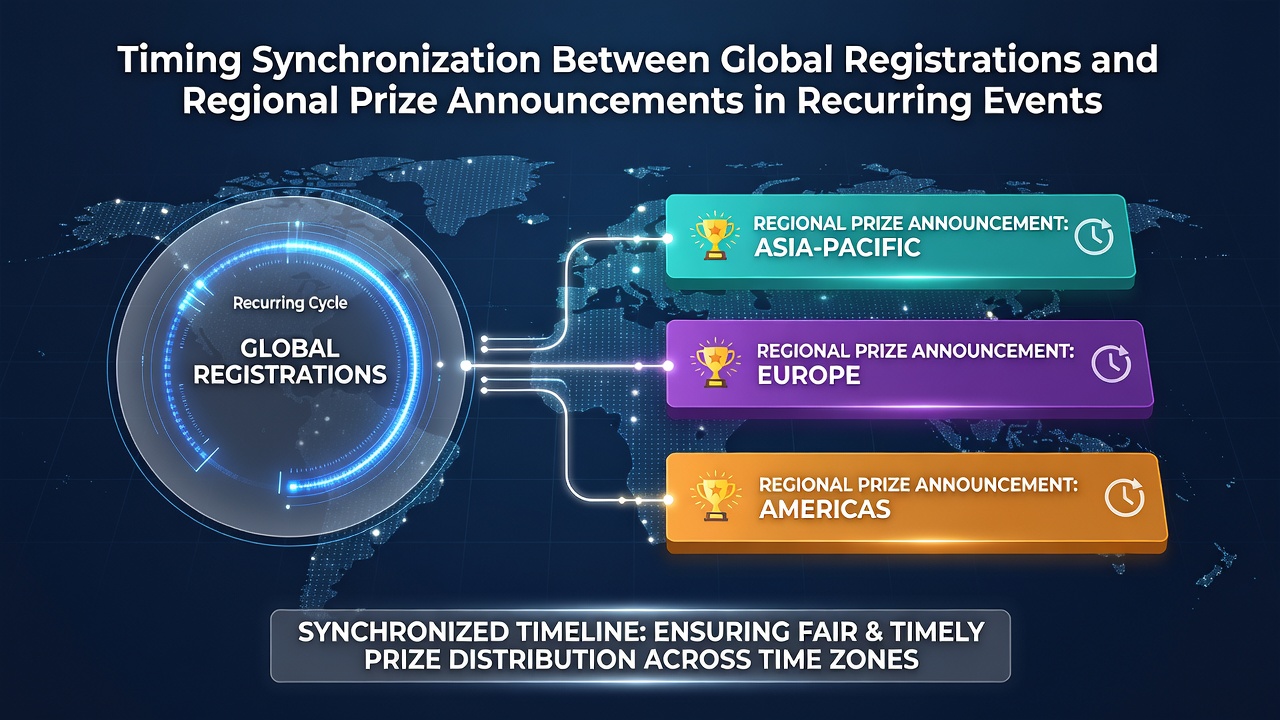
Global registration systems collect entries continuously across twenty-four-hour cycles, yet regional prize announcements typically cluster around local business hours or regulatory filing deadlines. According to figures released by the Australian Competition and Consumer Commission, more than sixty percent of cross-border promotions in 2025 adjusted their announcement windows by at least four hours to match the earliest participating time zone. This practice ensures that participants in Asia receive notifications before those in the Americas, while the underlying entry pool remains frozen at the moment the first regional draw occurs.
Platforms achieve synchronization by embedding region codes into each entry record, then triggering announcement protocols only after every preceding zone has closed its registration window. Those who maintain these systems report that software flags any entry logged within thirty minutes of a regional cutoff, prompting manual review to confirm eligibility under the correct jurisdiction. The result appears in public schedules that list both the universal registration end date and the staggered announcement sequence for each territory.
Challenges Arising from Time Zone and Regulatory Differences
Time zone variations create the most persistent friction points, because an announcement scheduled for 9 a.m. Eastern Time on a given day already falls on the following calendar date in parts of Oceania. Data indicates that recurring events held monthly experience a seven percent increase in disputed entries during periods when daylight saving transitions occur in multiple countries simultaneously. Organizers therefore publish separate rule sets for each region, and these documents specify the exact moment when entries become ineligible even if the global portal remains technically open.
Regulatory bodies further complicate timing because some jurisdictions require winner lists to be filed with government offices before public release, whereas others permit immediate posting once verification completes. The Federal Trade Commission in the United States, for example, outlines record-keeping obligations that can add twenty-four to forty-eight hours between draw execution and announcement, and similar requirements exist under Canadian provincial gaming authorities. Platforms reconcile these differences by maintaining parallel announcement queues that release information only after all regulatory prerequisites for a given region have been satisfied.

Implementation in Recurring Promotional Calendars
Monthly and quarterly events illustrate the synchronization process most clearly, since their repeated cycles allow organizers to refine timing protocols over successive iterations. One documented case involved a technology company that ran a recurring device giveaway throughout 2025 and 2026, with registration closing at midnight UTC on the final day of each month. Regional announcements then followed a fixed sequence: Asia-Pacific at 10 a.m. local time the next day, Europe at 2 p.m. CET, and the Americas at 11 a.m. EST. This cadence ensured that no announcement preceded the closure of any earlier time zone, and participation logs showed consistent entry volumes across regions after the pattern stabilized.
August 2026 presents an additional layer because several major recurring promotions coincide with both northern hemisphere summer holidays and southern hemisphere winter breaks, shifting typical announcement times by up to three hours in affected markets. Event calendars published ahead of that period already list adjusted filing deadlines with regulatory agencies in multiple countries, demonstrating how organizers prepare synchronization frameworks well in advance of calendar anomalies.
Technical Tools Supporting Synchronization
Database architectures used by large promotion platforms incorporate timestamp normalization and region-specific trigger conditions that execute automatically once all prerequisites align. Observers note that these systems log every adjustment made to announcement times, creating audit trails that satisfy both internal compliance teams and external regulators. When an entry originates near a regional boundary, the software cross-references the participant's declared address against GPS-derived location data to assign the correct announcement queue, reducing manual intervention to less than two percent of total entries in recent campaigns.
Integration with external calendars maintained by government agencies allows platforms to account for public holidays that might delay regulatory filings, and such integrations update dynamically as new jurisdictions publish their holiday schedules for 2026 and beyond. The outcome is a predictable sequence that participants can reference through dedicated status pages, each displaying the precise moment their region's announcement window will activate.
Conclusion
Effective timing synchronization in recurring events rests on standardized UTC baselines, region-coded entry records, and staggered announcement protocols that respect both time zone offsets and regulatory filing requirements. Platforms continue to refine these processes through iterative adjustments, and data collected across multiple cycles confirms that precise coordination reduces eligibility disputes while maintaining transparency for participants worldwide.