Social Echo Effects: Tracing How Viral Shares Reshape Draw Visibility Cycles in Global Prize Networks
Noah Vogel · Jun 11, 2026
Social Echo Effects: Tracing How Viral Shares Reshape Draw Visibility Cycles in Global Prize Networks
Observers in the sweepstakes and contest industry have tracked how social media amplification creates feedback loops that alter participant pools and timing structures in recurring prize events, and these patterns extend across multiple continents where networks coordinate draws with varying frequencies. Viral shares function as accelerators that push contest announcements beyond initial subscriber lists into broader audiences, which in turn influences how organizers adjust announcement schedules and eligibility parameters to manage increased volume.
Mechanisms Driving Echo Propagation
Shares on platforms generate secondary exposure when recipients forward links through their own networks, and this process compounds when recipients in different time zones participate during overlapping windows. Data from promotion aggregators shows that contests featuring shareable entry mechanics often experience entry spikes within 48 hours of initial posting, while those without such features maintain steadier but lower trajectories. Researchers who examined multi-platform campaigns found that cross-posting on visual networks produces longer tail visibility compared to text-only channels because images and short videos travel further through algorithmic recommendations.
Global prize networks respond to these surges by recalibrating their draw cycles, sometimes compressing announcement intervals when entry numbers exceed projected thresholds, and this adjustment maintains fairness while preventing administrative overload. Those who monitor participation metrics note that visibility cycles lengthen during periods of high sharing because organizers extend registration periods to accommodate new entrants from previously untapped regions.
Visibility Cycles and Their Adjustment Patterns
Draw visibility cycles refer to the intervals between promotion launch, peak awareness, and winner declaration, and viral activity compresses the awareness phase while stretching the participation phase. In June 2026 platform reports indicated that contests experiencing rapid share growth adjusted their daily and weekly draw frequencies upward in several cases to process larger applicant volumes without backlog. This recalibration occurs because networks rely on predictable entry curves to allocate judging resources, yet external amplification disrupts those curves and forces real-time modifications.
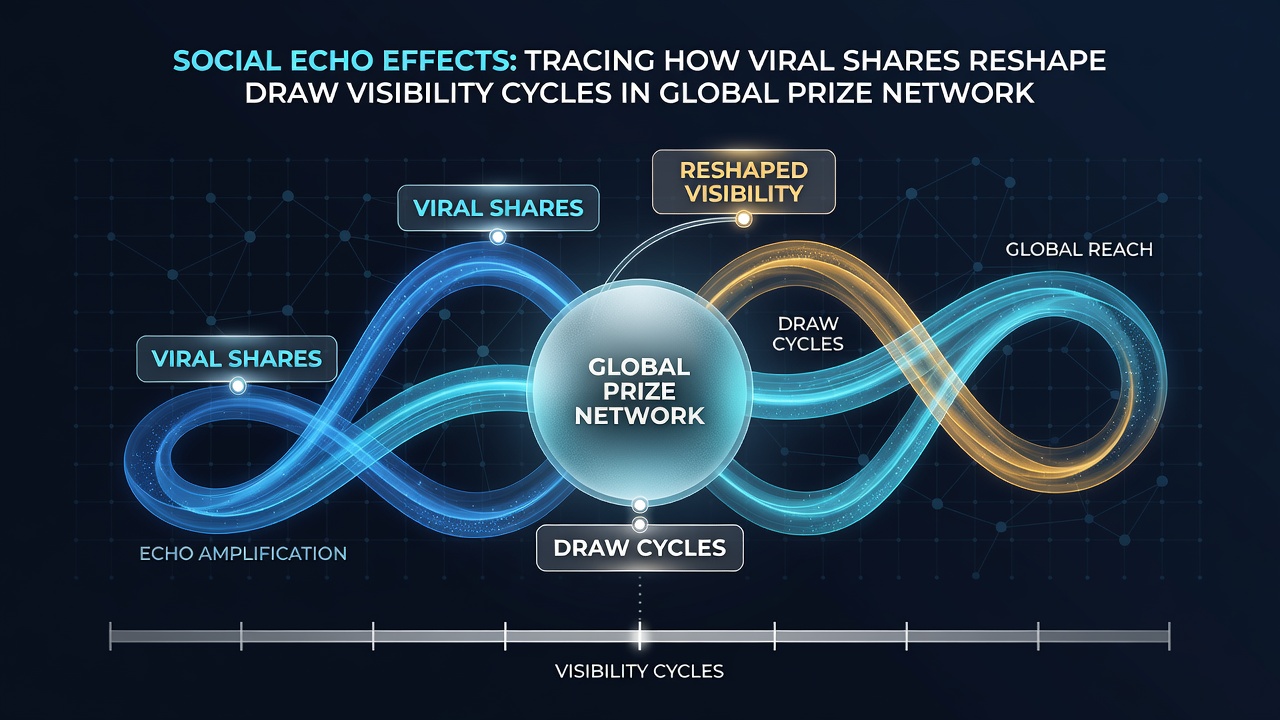
Analyses of recurring promotions reveal that cycles tied to weekly draws demonstrate greater flexibility than monthly formats when social echoes intensify, since weekly structures allow quicker incorporation of new participants before the next selection occurs. Observers have documented cases where networks in North America and Europe synchronized their announcement cadences after observing similar share-driven spikes on both continents, creating more uniform global timelines that reduce regional disparities in access.
Cross-Border Ripple Dynamics
International eligibility rules interact with viral spread when shares reach users outside original geographic scopes, and organizers must then update terms or issue clarifications to maintain compliance. Figures from regulatory bodies such as the Federal Trade Commission highlight that clear disclosure of eligibility boundaries becomes critical once content travels beyond intended markets. Networks operating across Asia-Pacific regions have adopted automated detection tools that flag entries from newly reached jurisdictions, allowing them to adjust visibility cycles without halting ongoing promotions.
Academic examinations of participation data further indicate that echo effects strengthen when prize values exceed certain thresholds, prompting wider organic distribution and subsequent cycle recalibrations by organizers. Those monitoring these trends point out that networks with established cross-border frameworks experience smoother adaptations because they already maintain flexible registration windows that absorb sudden influxes.
Long-Term Cycle Evolution
Over multiple iterations, repeated viral episodes lead some networks to embed social amplification forecasts into their planning models, which stabilizes visibility cycles despite unpredictable sharing patterns. Industry reports compiled by research institutions show that contests designed with modular timing components adapt more readily because segments of the cycle can shift independently without affecting the overall structure. This modular approach appears in promotions that separate registration from draw phases, allowing the latter to remain fixed while the former extends in response to echo-driven demand.
Canadian regulatory guidance from the Competition Bureau underscores the importance of transparent rule updates when participation surges alter expected timelines, and networks that publish such updates promptly maintain higher retention among repeat entrants. Observers note that these transparency measures also mitigate confusion when new participants arrive through shared links rather than direct discovery.
Conclusion
Social echo effects continue to influence how global prize networks structure their draw visibility cycles, with viral shares prompting adjustments in frequency, duration, and regional coordination. Data accumulated through 2026 demonstrates consistent patterns where amplified content drives larger, more diverse participant pools that require responsive scheduling frameworks. Networks incorporating these dynamics into operational models achieve greater consistency across recurring promotions while preserving compliance across jurisdictions.