Deciphering Verification Bottlenecks in Worldwide Recurring Promotion Access Protocols
Zara Klein · Aug 23, 2026
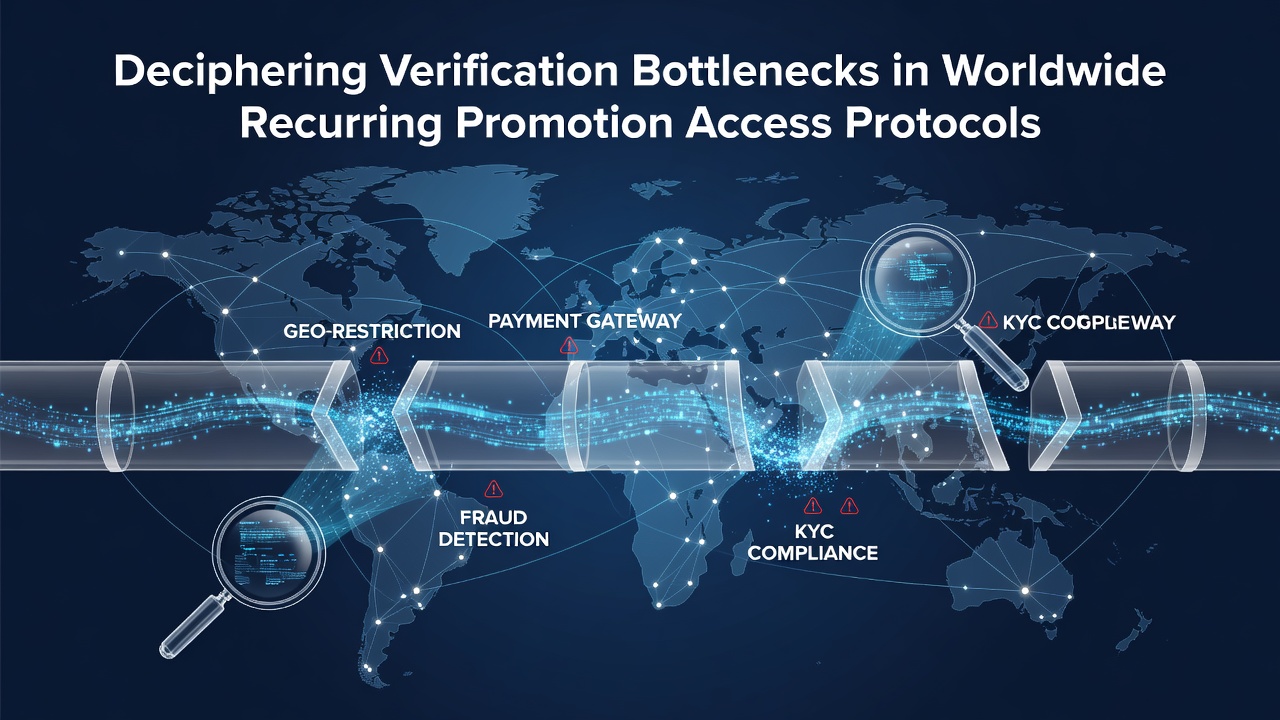
Deciphering Verification Bottlenecks in Worldwide Recurring Promotion Access Protocols
Verification protocols in recurring promotion access systems handle identity confirmation and eligibility checks for participants entering multiple draws over extended periods, yet these systems encounter persistent bottlenecks when data flows cross national borders and regulatory zones. Researchers tracking promotion networks note that mismatches in document formats, address validations, and consent records frequently stall processing queues, particularly in campaigns that run daily or weekly across dozens of countries.
Core Elements of Verification Workflows
Access protocols typically combine automated screening tools with manual reviews, where algorithms first parse submitted details against databases maintained by government registries and financial institutions, after which flagged entries move to human operators for deeper examination. Data from regulatory filings shows that in August 2026 several international promotion organizers reported average verification times extending from two days to nearly seven when participants resided outside the primary operating jurisdiction.
Eligibility rules vary sharply by region, requiring systems to apply different age thresholds, residency proofs, and prior-winner restrictions simultaneously, which creates layered decision trees that slow throughput during peak entry periods. Observers note that promotions spanning North America, Europe, and Asia-Pacific zones must reconcile these differences without triggering rejections that later require appeals.
Regional Regulatory Influences on Processing Speed
North American frameworks emphasize consumer protection disclosures while European standards prioritize data minimization under privacy statutes, forcing verification platforms to maintain separate compliance modules that do not always communicate seamlessly. Figures released by the Federal Trade Commission indicate that cross-border entries experience higher query volumes during summer months, when many recurring campaigns align registration deadlines with holiday travel schedules.
Canadian and Australian authorities apply distinct documentation standards for proof of address, prompting additional verification steps when participants submit forms accepted in one country but not another. Industry reports compiled by research groups affiliated with the University of Toronto highlight that these discrepancies account for roughly thirty percent of delays logged in multi-jurisdictional promotion databases as of mid-2026.

Technical and Data-Related Chokepoints
Legacy database architectures still used by some promotion platforms struggle to accommodate real-time updates from multiple national identification systems, resulting in temporary lockouts when synchronization lags occur. Studies conducted by academic teams at technical universities in Singapore and Germany found that API call failures between verification services spike during high-volume entry windows, especially when campaigns accept mobile uploads from regions with inconsistent internet infrastructure.
Encryption requirements and consent logging add further processing overhead, because each jurisdiction demands its own audit trail format, which platforms must generate and store separately. Those who manage large-scale recurring promotions report that maintaining parallel audit logs consumes significant server resources and occasionally produces conflicting timestamps that trigger secondary reviews.
Strategies Observed in Operational Adjustments
Promotion administrators have begun routing certain verification tasks through regional partner organizations that already hold local compliance certifications, thereby shortening the chain of required data handoffs. Evidence gathered from operational reviews shows this distributed approach reduces average clearance times by up to forty percent in campaigns that previously centralized all checks in a single location.
Automated retry mechanisms now re-submit failed queries after short intervals, allowing systems to recover from transient network issues without human intervention. Data compiled through 2026 indicates that campaigns incorporating these retry loops experienced fewer participant drop-offs during the verification stage compared with earlier implementations that lacked such features.
Conclusion
Worldwide recurring promotion access protocols continue to face verification bottlenecks rooted in regulatory divergence, technical interoperability gaps, and documentation inconsistencies across borders. Organizations that map these friction points and adopt regionally distributed processing models demonstrate measurable improvements in throughput, while ongoing monitoring of regulatory changes remains essential for maintaining efficient participant access as promotion networks expand.